
Sep . 08, 2025 15:55 Back to list
Pink Bauxite's Geological Significance And Rarity Factors
Bauxite, the primary ore of aluminum, paints the Earth in hues of red, brown, yellow, and white. Yet among these common shades lies a geological rarity—pink bauxite. This captivating variant isn’t merely a visual marvel; it embodies unique formation conditions, mineralogical quirks, and immense industrial value. For industries ranging from refractories to abrasives, understanding pink bauxite unlocks insights into Earth’s hidden chemical artistry and resource potential. Xingtai Luxi Environmental Protection Technology Co., Ltd., a leader in metallurgical materials since 2013, leverages such geological wonders to deliver premium bauxite and calcined bauxite solutions. Join us as we explore the science, scarcity, and applications of this rosy anomaly.
The Genesis of Bauxite: A Tropical Time Capsule
Bauxite forms through the intense weathering of aluminum-rich rocks like granite or basalt in hot, humid climates. Over millennia, rainwater leaches silica and soluble ions, concentrating aluminum hydroxides (gibbsite, boehmite, diaspore) and iron oxides. This laterization process creates residual deposits in pockets across tropical belts. Unlike metallic ores forged in volcanic fury, bauxite is a patient product of chemical decay—a literal "soil" turned to stone.
Geologically, bauxite acts as a paleoclimate indicator. Its presence signals epochs of sustained heat and rainfall. For instance, China’s Henan and Shanxi deposits formed during the Carboniferous period (300‒360 MYA), when swampy forests dominated the landscape. These deposits often overlay limestone karst landscapes, where concave topography traps weathered residues.
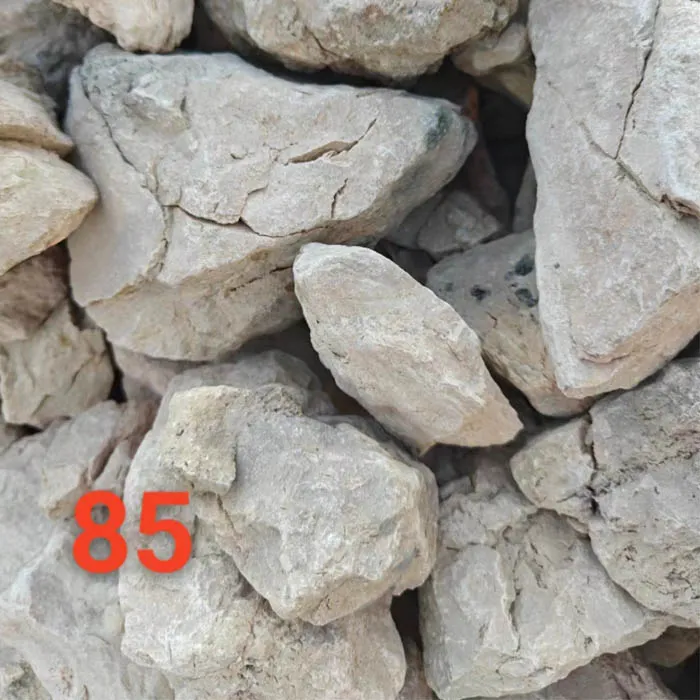
Xingtai Luxi harnesses these ancient formations to produce high-purity bauxite, rigorously graded for industrial use. Our ore meets exacting specifications, ensuring optimal alumina content and minimal impurities:
|
Product |
Size (mm) |
Al₂O₃ (%) |
SiO₂ (%) |
CaO (%) |
Fe₂O₃ (%) |
MC (%) |
|
Bauxite 88 |
0-1, 1-3, 3-5 |
>88 |
<9 |
<0.2 |
<3 |
<2 |
|
Bauxite 85 |
0-1, 1-3, 3-5 |
>85 |
<7 |
<0.2 |
<2.5 |
<2 |
Such consistency is vital. High Al₂O₃ boosts melting resistance in refractories, while low SiO₂/CaO prevents slagging in steelmaking. Uniform sizing (0‒5mm) ensures efficient calcination and reactivity—cornerstones of our ISO 9001-certified quality.
Calcined Bauxite: Engineering Earth’s Endurance
Raw bauxite gains superpowers through calcination. Heating ore to 1,500‒1,700°C dehydrates aluminum hydroxides, transforming them into stable, corrosion-resistant α-alumina (Al₂O₃). This process, executed in rotary kilns, also burns off organic matter and sulfur, yielding calcined bauxite—a dense, inert material prized for extreme environments.
The metamorphosis is profound:
Hardness skyrockets (Mohs 8.5‒9), making it ideal for abrasives.
Porosity drops, enhancing thermal shock resistance in furnace linings.
Chemical inertness allows use in corrosive settings like chemical plants.
Calcined bauxite’s value lies in its tailored properties. For example, low-iron variants (Fe₂O₃ <2.5%) are essential for white ceramics, while coarse grains (3‒5mm) anchor anti-skid road surfaces. At Xingtai Luxi, our calcined bauxite undergoes stringent phase analysis to guarantee >85% corundum content—critical for refractory bricks lining steel ladles or cement kilns.
Pink Bauxite: Nature’s Chromatic Rarity
So, what paints bauxite pink? Unlike red bauxite, colored by hematite (Fe₂O₃), or white bauxite, bleached by kaolinite, pink bauxite owes its hue to trace manganese oxides and unique diaspore crystals. Manganese (Mn³⁺), substituting for aluminum in gibbsite lattices, absorbs green light and reflects rosy tones—akin to ruby’s chromium magic. Diaspore-rich varieties also scatter light differently than boehmite-dominated ores, amplifying pastel shades.
Pink bauxite’s rarity stems from three factors:
Precise Geochemistry: Mn concentrations must hit 0.3‒0.8%—too low for color, too high for structural integrity.
Low-Iron Host Rocks: Parent materials need <1.5% Fe₂O₃ to avoid masking pink with red.
Shallow, Oxidized Depths: Pink zones often cap deposits, vulnerable to erosion.
Globally, major finds are scarce. China’s Guizhou province yields limited pink bauxite alongside its famed karst landscapes. Turkey’s Seydişehir mines occasionally produce pinkish diaspore ores. Brazil’s Pará state has isolated lenses. Even in these regions, <5% of bauxite qualifies as gem-grade pink.
Geologically, pink bauxite signals highly evolved laterization. Its color indicates prolonged oxidative weathering—a "mature" deposit where silica leaching reached completion. For miners, it’s both a novelty and a high-value niche. Xingtai Luxi selectively sources such ores for premium refractory applications, where aesthetics meet performance in specialized ceramics.
FAQs: Unlocking the Value of Our Bauxite Solutions
What distinguishes your bauxite’s purity levels?
Our Bauxite 88 (>88% Al₂O₃) delivers maximum alumina for high-temperature refractories, while Bauxite 85 (>85% Al₂O₃) offers cost-efficiency for foundry fluxes. Both grades feature ultra-low CaO (<0.2%) and SiO₂ (<9%), reducing slag formation in steelmaking. Rigorous size sorting (0-1mm, 1-3mm, 3-5mm) ensures uniform calcination and reactivity.
Why choose calcined bauxite over raw ore?
Calcined bauxite eliminates volatile impurities, boosting density, hardness, and thermal stability. It resists spalling in kiln linings, maintains grip on epoxy-coated runways, and sharpens consistently as abrasive grains. Our rotary-kiln processing achieves 95% alumina conversion, guaranteeing longevity in extreme conditions.
Is pink bauxite functionally superior?
While visually striking, pink bauxite’s value lies in its diaspore/manganese matrix, which enhances sintering behavior in specialty ceramics. It forms denser, more crack-resistant refractories than common varieties. However, its scarcity makes it premium-priced—ideal for high-margin applications like precision insulators or decorative firebricks.
Can your bauxite meet custom size specifications?
Absolutely. We offer tailored crushing and screening for sizes from 0-0.5mm (micro-grains for coatings) to 5-10mm (coarse aggregates). Custom sizing optimizes packing density in refractory mixes or flow rates in casting processes, minimizing waste and energy use.
How does your calcined bauxite ensure batch consistency?
Every lot undergoes XRF spectrometry to verify Al₂O₃/SiO₂ ratios and XRD phase analysis. Our ISO 9001 protocols enforce strict kiln temperature gradients and residence times, preventing under-calcination (which leaves pores) or over-calcination (which causes brittleness). Result? Uniform hardness (≥8.5 Mohs) and zero shrinkage in end products.
Pink bauxite is more than a geological curiosity—it’s a testament to nature’s precision. Its formation demands a ballet of chemistry, climate, and time, yielding a material as rare as it is resilient. For Xingtai Luxi Environmental Protection Technology Co., Ltd., such nuances drive innovation. Located in Hebei’s Longgang Economic Development Zone, our 130,000 m² facility blends advanced processing with stringent ISO 9001 standards to transform raw bauxite into high-performance calcined bauxite.
From our flagship GPC recarburizer to bauxite refractories exported to Japan, Italy, and beyond, we prioritize qualities that redefine efficiency: low nitrogen, high absorptivity, and unwavering consistency. Whether leveraging the robustness of common bauxite or the niche excellence of pink bauxite, we engineer solutions where earth’s hidden artistry fuels industrial progress.
-
Professional Boiler Refractory Material Supplier for Industrial Efficiency
NewsApr.16,2026
-
How to Choose the Best refractory materials suppliers for Success
NewsApr.09,2026
-
Understanding Refractory Bricks Raw Materials for High Temperature Applications
NewsApr.07,2026
-
PLIbrico Refractory Materials Understanding Applications and Benefits
NewsApr.04,2026
-
Advancements in Reversible Thermal Expansion Refractory Materials for High Temperature Applications
NewsMar.31,2026
-
Comprehensive Guide to Refractory Kiln Lining Material Selection and Applications
NewsMar.28,2026